Rain swept across Kings Park more than once during the Commemoration of Women in the Armed Forces of Australia.
It came and went as the service continued. Around the State War Memorial stood banners representing every branch of service - visible reminders that women belong to the history of each one.
Despite the weather, it was a wonderful service. Perhaps the rain made the act of remembrance feel even more present. We were not reading names at a comfortable distance. We were standing together, listening as the weather moved through.
Four women were acknowledged in particular: Sister Frances Emma “Fanny” Hines, Squadron Officer Eleanor Brett, Warrant Officer Patricia McLeod and Lieutenant General Susan Coyle.
Placed together, their stories formed something larger than four individual biographies. They showed the evolution of women's service in Australia's armed forces - from colonial military nursing, through separate women's services, into an integrated Australian Defence Force and, now, the highest level of Army leadership.
When I think about women's service in Australia, I do not begin only with an abstract statistic.
I think about the ordinary texture of military work: the equipment, the procedures, the shifts and the responsibility of getting the message through.
During my own RAAF chapter, I worked with Model 40/8 communications equipment and telex machines. Coded tape was not a decorative reference. It was part of the job. Service was practical, disciplined and real.
So was the service of the women who came before me, those who served beside my generation and those serving now.
Yet ask someone to picture an Australian veteran and the image that comes to mind is still often a man.
That picture is incomplete.
Women have nursed near battlefields, maintained aircraft, operated signals, driven military vehicles, worked in intelligence, sailed, flown, deployed and led. Their service was never absent from Australia's military history.
Too often, recognition was.
Women were always part of the story
Australian women's military service reaches back further than many people realise.
About 60 nurses from the Australian colonies served during the South African War of 1899 to 1902. During the First World War, 2,861 members of the Australian Army Nursing Service served overseas. Twenty-five died during their service.
The Second World War widened the roles available to women. From 1941, women began serving in non-medical positions across the Navy, Army and Air Force. The language of the period often described their work as releasing men for combat, but that description does not convey the skill, discipline and responsibility their work required.
Approximately 27,000 women enlisted in the Women's Auxiliary Australian Air Force between 1941 and 1947. They worked in communications, transport, administration and technical roles, including aircraft maintenance.
The Australian Women's Army Service was the only non-medical women's service to send personnel overseas during the war. More than 3,000 women enlisted in the Women's Royal Australian Naval Service, undertaking work that included wireless telegraphy and signals intelligence.
They were not standing at the edge of military history. They were helping to make it.
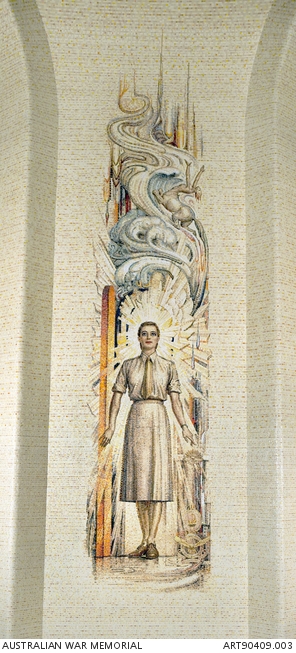
Invisible does not mean absent
The word invisible matters here.
It does not mean that women were missing. It describes what happens when their service is treated as secondary, assumed to be supportive rather than skilled, or left out of the picture altogether.
That invisibility can continue after the uniform is put away.
Department of Veterans' Affairs research has recorded women being questioned about the medals they were wearing or being assumed to be a veteran's daughter or wife rather than the veteran herself. A DVA study of women who served during the Vietnam era also found that many participants did not identify themselves as veterans, despite active service, deployments or combat-like roles.
Recognition is not simply a matter of courtesy. It affects belonging. It can influence whether a woman sees an RSL, a commemorative space, a health service or a veteran support program as somewhere she is entitled to be.
If the public image of a veteran remains narrow, some of the people who served will continue to stand outside it.
What the present-day evidence tells us
Women are a growing part of Australia's serving and veteran communities.
Using 2021 Census data, DVA estimated that women made up 13.4 per cent of Australia's veteran population and 20.6 per cent of serving Australian Defence Force members. DVA also acknowledged that the actual number of women veterans may be higher because some women choose not to identify with their service after leaving the ADF.
The Women Veterans 2025 Baseline Data Report adds another layer to the picture. It found that 52.1 per cent of women veterans reported at least one long-term health condition, compared with 35.9 per cent of women who had never served. It also found that women veterans were almost twice as likely as male veterans to perform 30 or more hours of unpaid domestic work each week.
These figures do not tell one universal story. No statistic can.
Women veterans differ in age, culture, branch, rank, role, length of service and experience. Many remember service with pride. Some carry injury, grief or experiences they still find difficult to name. Many hold pride and pain together.
Honest recognition has to leave room for that complexity. We can honour service without romanticising every part of it. We can acknowledge progress without pretending the work is complete.
Four women, more than a century of service
On Saturday, 8 August 2026, the Commemoration of Women in the Armed Forces of Australia was held at the State War Memorial in Kings Park, Western Australia.
RSL WA described the service as an occasion to honour the service, sacrifice and achievements of women across all branches of Australia's armed forces, in war and in peace. I was fortunate to attend.
The banners representing every service gave that broad history a physical presence. But the stories of four women gave it a human shape.
Sister Frances Emma “Fanny” Hines
Sister Hines served with the Victorian 3rd Bushmen's Contingent during the South African, or Boer, War. Working in primitive and overcrowded conditions, she was at one point solely responsible for as many as 26 patients.
She died of pneumonia on 7 August 1900, contracted in the course of her duties. She is recognised as the first Australian woman to die on active military service and was the only Australian nurse to die during service in the Boer War.
Her place at the beginning of this commemorative line matters. Before Australia was a federated nation, a woman was already serving, carrying responsibility and giving her life in that service.
Squadron Officer Eleanor Brett
Eleanor Brett's service connected two eras of the Air Force. She served in the Women's Auxiliary Australian Air Force during the Second World War and later helped shape the Women's Royal Australian Air Force from its early implementation in 1951. Her service continued into the mid-1960s.
Contemporary records refer to her WRAAF rank as Squadron Officer, the women's-service equivalent of Squadron Leader. She took on the work of turning a newly formed group of recruits into an efficient and disciplined service.
Her story represents both continuity and change: women returning to serve after the wartime WAAAF had been disbanded, then building the permanent women's Air Force that would eventually be integrated into the RAAF.
Warrant Officer Patricia McLeod (née Anders)
Warrant Officer Patricia McLeod's WRAN and RAN service represented the movement from a separate women's naval service into an integrated Navy.
That transition was more than a change of acronym. It reflected a deeper change in belonging. Women were no longer serving alongside the Navy in a distinct organisation; they were members of the Royal Australian Navy.
Her inclusion made the evolution personal. Institutional change is recorded in dates and policies, but it is lived by the people who continue serving while the organisation changes around them.
Lieutenant General Susan Coyle, AM, CSC, DSM
At the other end of the line stood Lieutenant General Susan Coyle, who assumed command as the 42nd Chief of Army in July 2026 - the first woman to lead the Australian Army.
Her appointment does not erase the barriers faced by earlier generations. It shows how far the path they helped open can now extend.
From Sister Hines serving before Federation to Lieutenant General Coyle leading the Army 126 years later, the four women honoured at Kings Park showed that women's military service is not one story or one era. It is a continuing line.
A wider remembrance
In his keynote address, Captain Ken Burleigh, RAN, Commanding Officer of HMAS Stirling, widened the remembrance beyond those four women. He also acknowledged women whose courage became part of Australia's Second World War story, including Nancy Wake - “the White Mouse” - and Sister Vivian Bullwinkel.
Their service took different forms.
Nancy Wake grew up in Australia and became a leading figure in the French Resistance. Later trained by Britain's Special Operations Executive, she returned to occupied France in 1944 to help organise resistance fighters and weapons drops before D-Day. The Gestapo called her the White Mouse because of her ability to evade capture.
Sister Vivian Bullwinkel served with the Australian Army Nursing Service. After the SS Vyner Brooke was sunk during the evacuation of Singapore in February 1942, she became the sole survivor when 21 of her fellow nurses were massacred by Japanese soldiers on Bangka Island. Wounded, she survived and later endured more than three years as a prisoner of war.
Remembering them together did not suggest that every woman's service was the same. It showed the breadth of courage and contribution: resistance work, intelligence and irregular warfare alongside nursing, captivity and formal military service.
Captain Burleigh's address placed the four women of note within a much larger company. For every well-known name, there are many more women whose work was essential but whose stories remain less familiar.
The importance of a dedicated commemoration lies partly in what it asks us to notice.
It asks us to look again at the historical photographs and see the technician, operator, nurse, driver, officer and leader - not simply “the women helping”.
It asks us to recognise that a woman wearing medals may be wearing her own.
It asks us to preserve stories before they disappear and to listen without requiring women to prove they belong in the veteran community.
Commemoration cannot recover every story that was minimised, omitted or lost. It can change which stories we choose to see now.
The rain passed through. The banners remained. So did the names.
A more complete picture
I know that service does not always look dramatic from the inside. Much of it is repetition, readiness and responsibility. It is learning the equipment, following the procedure and doing your part when other people depend on it.
That work counts.
The women who served Australia were never a footnote. Their contribution runs through our military history and continues in the ADF today.
We honour them by learning their names, recording their experiences and widening our idea of who a veteran can be.
Their service was never absent.
It is time for it to be fully seen.
Reflection prompt: When you picture an Australian veteran, whose face appears first - and whose service might still be missing from that picture?
Header image: Anne Ferguson, Australian servicewomen’s memorial, 1999, granite mosaic. Australian War Memorial, ART90968. © Australian War Memorial, licensed CC BY-NC.